25 June 2009
What would COMMUNITY DRIVEN development look like?
19 June 2009
Vision for Future Developement
Retail + Workforce Housing + Transit Oriented Development + Sustainable Design x Green Technology = Wilson Yard’s Vision for the Future

What the developer requested: a mixed-use development on a wedge-shaped former rail yard site, including a vertical urban Target store, affordable and senior housing, new Aldi store, ground-floor retail and offices on upper floors.
What the design team responded with is not just Transit-Oriented Development-based mixed use integrated urban shopping, nor only a new Target store anchoring an environmentally-friendly, multi-use development project – through admittedly it is both of these. What they created – with shopping and a little political finagling – is nothing short of a complete transformation of a tired neighborhood into a thriving, living, breathing community.
What they created is Wilson Yard.

With Wilson Yard the future isn’t tomorrow or next year – the future is now. To evidence this you need not look any further than the Transit-Oriented Development: a vibrant, livable, compact and walkable shopping environment centered on high-quality train and bus systems – all perfectly attuned to our times.
Wilson Yard works on many levels. By incorporating the best tenets and practices of urban planning and design, sustainable design, affordable workforce housing and green technology, the project achieves something more, beyond the realization of a well-designed retail project. The development ultimately completes and heals the site, neighborhood and community where it resides. It’s a case of the universal in the particular. By providing exactly what is needed at the right time and in the right place you end up envisioning the shopping environment of the future.

Covering a full city block, the resulting project is a veritable Rubik’s cube offering shoppers and pedestrians a continuous, seamless shopping environment of integrated interlocking components.
Future-looking without being futuristic, Wilson Yard is an out-of-the-Big-Box, innovative idea that progresses everyone’s current understanding of what the shopping experience can ultimately be.
Anchor: The retail anchor, a new 180,000 square-foot two level Target store with an energy-saving green roof.
The Matrix: 25,000 square feet of additional retail – forming the proverbial simple line of outwardly facing stores and office space – here marrying the project’s anchor with the residences along an attractive new streetscape.
Urban Density: Two rental buildings with affordable units including a mixed-income building accommodating 84 families in one-, two-, and three-bedroom apartments and an accompanying seniors complex with 99 affordable one-bedroom unites.
Green Technology: In keeping with Mayor Daley’s ongoing commitment to make Chicago a showpiece city for green technology, the Wilson Yard project will be certified LEED SILVER, the nationally accepted benchmark for the design, construction, and operation of green buildings by the U.S. Green Building Council. The project’s sustainable components include green roofs and a solar-reflective roofing system for the residential buildings, collection of storm water and controlled release of waste water, a new green space to serve as the outdoor campus for a neighboring elementary school, and reclaimed parking space beneath the CTA ‘L’ tracks.
Our futuristic vision of the retail real estate industry? It’s being built right here today.
The above project is currently being developed and was designed by FitzGerald Associates based in Chicago.04 May 2009
Fun with Chalk

The City hosted the 11th Annual Fun with Chalk event over the weekend and had nearly 9,000 visits over the course of the event. This type of event is excellent in engaging the community; residents not only view and discuss, many of them participate.
Messaging through art is a powerful tool.
Express yourself. Kids participating with their own square.
Involving the community is vital and engaging.
30 April 2009
Simon Malls looks to engage the community


28 April 2009
The Phenomenon of Dying Malls
American malls have been around for less than a century, but their influence on our culture has been amazing. However, even in prosperous times, distressed malls have been a persistent problem, as well as a point of intrigue in the suburban landscape. The current economic slump has magnified the problems that ailing malls have been battling for years, or even decades.
Vacant malls, strip center shopping centers and big box stores have already been redeveloped into more sustainable, less auto-dependent places more in sync with today’s demographics. Depending on the specifics of each site, we can expect to see future failed malls re-inhabited, re-greened, or retrofitted. Essentially malls can be repositioned into what a community needs. When a mall dies, many options are on the table. Redevelopment into a more sustainable mixed use center is often a good solution if the real estate is valuable. They have the advantages of an already existing infrastructure and usually are located on major transportation routes. They should be regarded as a potential asset, much as you would look at well-located unimproved land, or a deserted warehouse or office district in a city center.
What should never be an option is to allow the building to sit neglected for years. Although it may be sad to see a place with so many memories bulldozed, there isn’t much future for an abandoned generic suburban shopping mall. The current crop of dying malls are by no means the end of the shopping mall. Retail and shopping are too integral a part of American life.Here are some examples fo successful re-use.
31 March 2009
OC MAYORS FORUM
- Did you know Mission Viejo is reinventing retail? The Shops at Mission Mall boast the largest solar installation of any U.S mall.
- Do you know Laguna Niguel residents are known for preferring to drive to work (source: American Community Survey)? How will this impact the city's plans to focus on redevelopment around the Laguna Niguel/Mission Viejo Metrolink station?
- Did you know Orange, Tustin and Laguna Niguel are ranked among 11 of the 34 cities in Orange County as the least costly to do business in (source: Rose Institute, Claremont McKenna College, 12/19/2008)?
- Did you know more young people, ages 24-35 are leaving Orange County today than any other age group (source: OCBC). Mayor Cavecche speaks of "handing off our legacy for future generations that will call Orange home" in her recent State of the City speech. How does a city attract and keep its young residents today? Ex: Are Chapman students staying to live and work in Orange after they graduate?
10 March 2009
How to create a culture of walking...
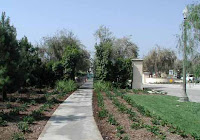
The trails in Mission Viejo are great for leisure and recreation, but not everyone lives like this 'Super Mom', out blazing the Oso Creek Trail for a little exercise. For the rest of us, we need to be coaxed into exercise to the point that we don't even know we are exercising. By creating enhanced walking experiences from desirable place to desirable place, can be that coaxing element.
Currently, when walking around Mission Viejo, we are offered the streets as our main connection element. The 5' wide curb adjacent sidewalk, next to a tiny and poorly maintained landscape setback, adjacent to a sea of asphalt at our underwhelming retail centers is not exactly a enhanced walking experience. Nor is it comfortable to traverse across the bridges in this city where you constantly feel like your going to be run over by a car.
So, what actions can be taken?
What we (the City staff and council, current property owners and incoming developers, and residents) need to do is:
- Actively encourage all members of the community to walk whenever and wherever they can as a part of their daily lives by developing regular creative, targeted information, in a way that responds to their personal needs and engages personal support.
- Create a positive image of walking by celebrating walking as part of cultural heritage and as a cultural event, for example, in architecture, art-exhibitions, theatres, literature readings, photography and street animation.
- Provide coherent and consistent information and signage systems to support exploration and discovery on foot including links to public transport.
- Financially reward people who walk more, through local businesses, workplaces and government incentives.
- Looking at future improvements by hitting the drawing boards with quality design consultants and with an open and flexible mind to providing creative solutions to real problems which exist in community today.

It's not too late to re-think the 'Masterplan'!
'Super Mom' was featured in a past article in the OC Register. All other photos taken by author. Some content courtesy of Walk21.